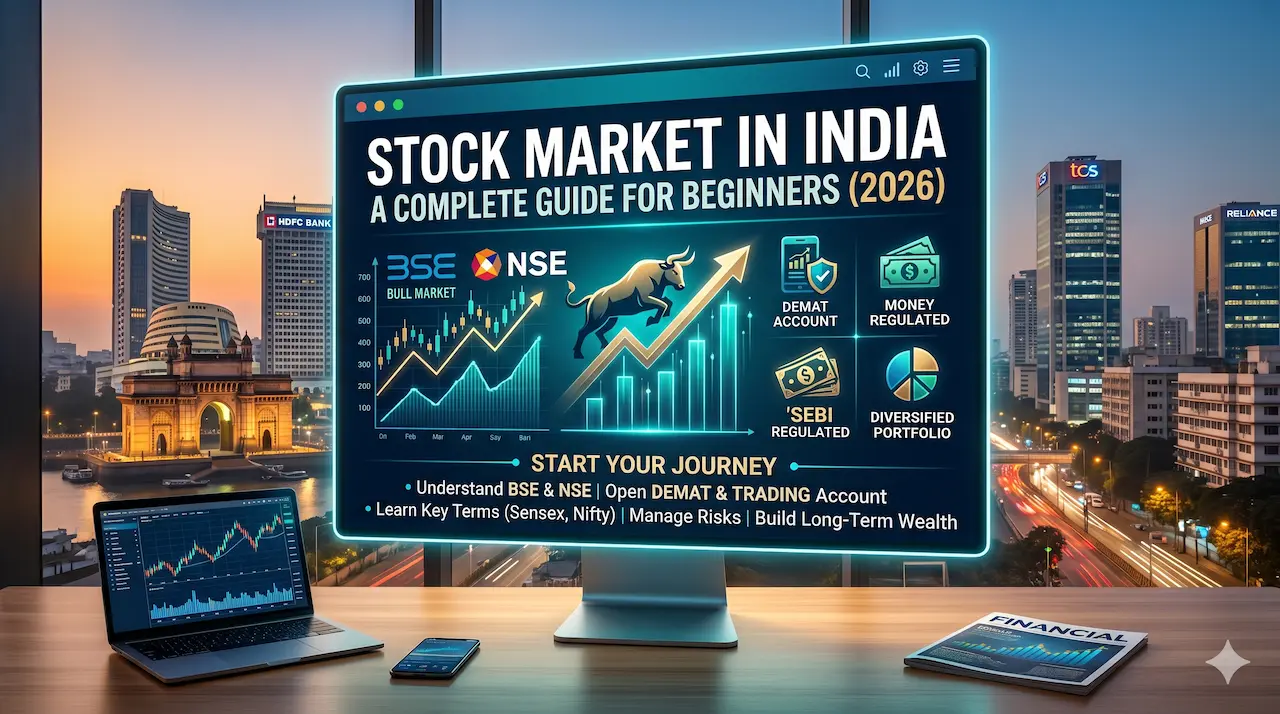
What is the Stock Market?
The stock market is a place where people buy and sell shares of companies. Think of it like a big marketplace – but instead of vegetables or clothes, people trade small pieces of ownership in companies like Reliance, TCS, or HDFC Bank.
When you buy a share of a company, you become a small owner of that company. If the company grows and earns profits, your share becomes more valuable. If the company does poorly, your share value goes down.
In India, the two main stock exchanges where this buying and selling happens are:
- BSE (Bombay Stock Exchange) – Asia’s oldest stock exchange, located in Mumbai. It has over 5,000 listed companies.
- NSE (National Stock Exchange) – India’s largest stock exchange by trading volume.
Why Do Companies List on the Stock Market?
Companies need money to grow. Instead of only taking loans from banks, they can sell small pieces of ownership to the public. This is called an IPO (Initial Public Offering).
For example, when a company needs ₹1,000 crore to build a new factory, it can sell shares to thousands of investors. Each investor contributes a small amount, and together they fund the company’s growth.
In return, investors get a chance to earn profits when the company grows.
How Does the Indian Stock Market Work?
Here is a simple step-by-step of how the stock market works in India:
- A company gets listed on BSE or NSE through an IPO.
- Investors open a Demat account (more on this below) and buy shares.
- Share prices change every day based on demand and supply – if more people want to buy a share, its price goes up; if more people want to sell, it goes down.
- SEBI (Securities and Exchange Board of India) regulates everything to protect investors from fraud.
Key Terms You Should Know
You don’t need to be a finance expert to invest. But knowing these basic terms will help a lot:
Sensex – This is the main index of the BSE. It tracks the performance of the top 30 companies listed on BSE. When people say “the market went up today,” they often mean the Sensex went up.
Nifty 50 – This is the main index of NSE. It tracks 50 large and well-established companies across different sectors like IT, banking, pharma, and energy.
Bull Market – When share prices are rising and people are optimistic. A bull market is a good time for investors.
Bear Market – When share prices are falling and people are worried. A bear market can be scary, but it can also be a good time to buy shares at lower prices.
Dividend – Some companies share a part of their profits with shareholders. This payment is called a dividend. It is like a bonus on top of your investment.
Portfolio – The collection of all the shares and investments you own is called your portfolio.
Demat Account – A Demat (Dematerialised) account is where your shares are stored digitally. You cannot trade in the Indian stock market without one.
How to Start Investing in the Indian Stock Market
Many people think the stock market is only for the rich or for finance experts. That is not true. Today, anyone with ₹500 and a smartphone can start investing. Here is how:
Step 1: Get a PAN Card
Your PAN (Permanent Account Number) is mandatory for investing in India. If you don’t have one, apply on the NSDL or UTIITSL website.
Step 2: Open a Demat + Trading Account
You need a Demat account to hold your shares and a trading account to buy/sell them. Most brokers offer both in one package. Popular options in India include:
- Zerodha
- Groww
- Angel One
- Upstox
- HDFC Securities
The process is online and takes just a few minutes. You’ll need your PAN card, Aadhaar card, and a bank account.
Step 3: Link Your Bank Account
Your trading account must be linked to your bank account to transfer funds for buying shares.
Step 4: Research Before You Invest
Do not put your money in a company just because a friend suggested it or you saw it trending on social media. Always check:
- What the company does
- How it has performed in the last few years
- Whether it has debt
- What experts say about its future
Step 5: Start Small
You don’t need lakhs of rupees to start. Many shares are priced under ₹100. Start with a small amount you can afford to lose, learn the market, and then invest more over time.
Types of Investments in the Stock Market
The Indian stock market offers different ways to invest:
Direct Stocks – You pick and buy shares of specific companies. High risk, but can give high returns if you choose well.
Mutual Funds – A fund manager pools money from many investors and invests it in a basket of stocks. This is a good option for beginners who don’t want to pick individual stocks.
SIP (Systematic Investment Plan) – You invest a fixed amount (say ₹500 or ₹1,000) every month in a mutual fund. Over time, this grows through the power of compounding. SIP is one of the easiest and safest ways for regular people to build wealth.
ETFs (Exchange-Traded Funds) – These are funds that track an index like the Nifty 50. They are cheap to buy and a great way to invest in many companies at once.
IPO (Initial Public Offering) – When a company is listed on the stock market for the first time, you can apply for its IPO. If the company is good, early investors can make good profits.
Is the Stock Market Safe?
This is one of the most common questions in India – and the honest answer is: it depends on how you invest.
The stock market does carry risk. Prices go up and down. You can lose money if you are not careful. But there are ways to reduce risk:
- Diversify your investments – Don’t put all your money in one company or one sector. Spread it across different companies and industries.
- Invest for the long term – The market may fall in the short term, but historically, the Indian market has always grown over 10-15 years.
- Don’t invest borrowed money – Never take a loan to invest in the stock market.
- Avoid following tips blindly – Many WhatsApp groups and YouTube channels give “sure shot tips.” Most of them are unreliable or even fraudulent.
SEBI (Securities and Exchange Board of India) is the regulator that protects investors. Always invest through SEBI-registered brokers.
Taxes on Stock Market Income in India
You need to pay tax on your stock market earnings. Here is a simple breakdown:
| Type of Profit | Holding Period | Tax Rate |
| Short-Term Capital Gain (STCG) | Less than 1 year | 20% |
| Long-Term Capital Gain (LTCG) | More than 1 year | 12.5% (above ₹1.25 lakh) |
| Dividend Income | – | Added to your income and taxed at your slab rate |
Note: Tax rules may change. Always check the latest rules or consult a tax advisor.
Common Mistakes to Avoid
Even smart people make these mistakes in the stock market. Learn from them before you invest:
Investing based on emotions – Buying when markets are at a high because “everyone is making money,” or panic-selling when markets fall. This is the biggest reason most people lose money.
Not doing research – Putting money in a stock just because the name sounds good or someone recommended it without any basis.
Timing the market – Trying to predict the exact best time to buy and sell. Even experts cannot do this consistently. It is better to invest regularly (through SIP) than to try to time the market.
Ignoring fees and charges – Brokerages charge fees (called brokerage) for every trade. If you trade very frequently, these fees can eat into your profits.
Expecting quick riches – The stock market is not a get-rich-quick scheme. Real wealth is built slowly over years.
Who Regulates the Indian Stock Market?
SEBI (Securities and Exchange Board of India) is the main regulator. It was established in 1992 and has the power to make rules, investigate fraud, and protect investors. If you ever face any fraud or problem, you can file a complaint on SEBI’s SCORES portal (scores.sebi.gov.in).
Other important bodies include:
- RBI (Reserve Bank of India) – Controls the flow of money in the economy, which affects interest rates and in turn the stock market.
- NSDL and CDSL – These are depositories that hold your shares digitally in your Demat account.
Final Thoughts
The Indian stock market has given great returns to investors who are patient and disciplined. The BSE Sensex, which was around 1,000 in 1990, has grown to over 70,000+ today. That is a remarkable growth over 30+ years.
You don’t need to be a finance expert. You don’t need lakhs of rupees. You just need to start, learn continuously, and be patient.
Whether you are a student, a working professional, a homemaker, or someone close to retirement – the stock market has something for everyone. Start small, stay consistent, and let your money grow over time.
Disclaimer: This article is for educational purposes only. It is not financial advice. Please consult a SEBI-registered financial advisor before making any investment decisions.
Frequently Asked Questions (FAQs)
Yes, if you are 18 or above, you can open a Demat account and start investing. If you are under 18, a guardian can open a minor account on your behalf.
You can start with as little as ₹500. Many mutual fund SIPs start at ₹100 per month.
No. Gambling is based purely on chance. Investing in the stock market is based on research, company performance, and economic factors. While there is risk, informed investing is very different from gambling.
The best time to invest is as early as possible. Even a small amount invested early grows significantly over time due to compounding.
If you invest in a single company and it goes bankrupt, yes, you can lose that money. But if you diversify across many stocks or invest in mutual funds, your risk is much lower.