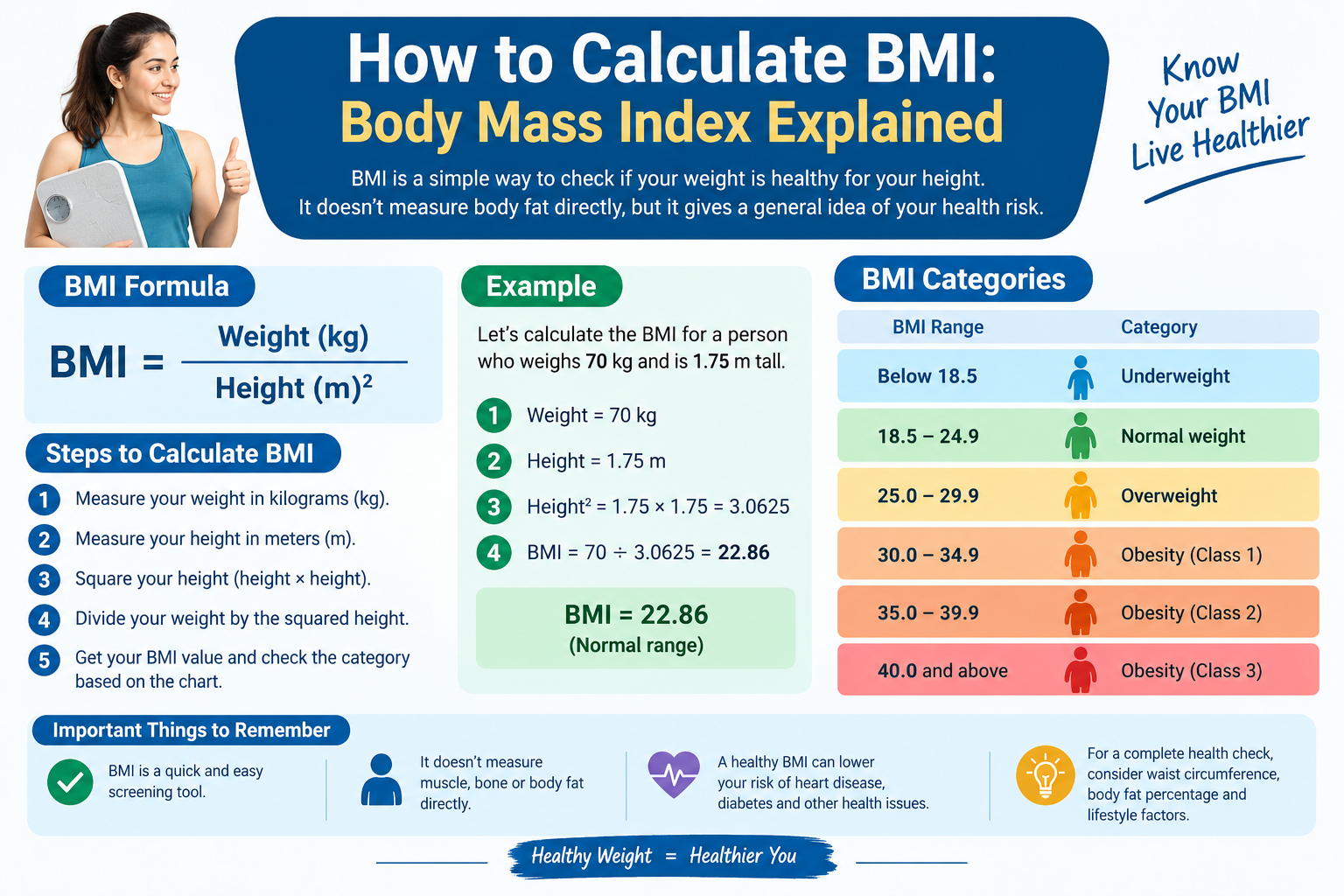
The Body Mass Index (BMI) is a nice way to test the health of the human body. This index is related to a person’s weight relative to his/her height and gives a figure that could help detect certain possible health threats associated with overweight/obesity. However, it does not cover all aspects of a person’s health condition. Still, it provides good information on health risks associated with being overweight.
Knowing how to calculate BMI is very important these days, especially for those who wish to have a health policy for future crises.
What Is Body Mass Index (BMI)?
BMI is a mathematical calculation that depends on a person’s height and weight. It is commonly used by doctors and other healthcare professionals as an early assessment to determine obesity, fat, and other health symptoms.
However, BMI cannot determine the exact amount of fat present in one’s body. The test does not indicate whether it is the bones, muscles, or fat causing the increase in body weight. For example, a fit male may have a high BMI because of muscle mass.
How to Calculate BMI?
Here is how to find your BMI based on the metric system of measurement. Source: CDC — About Body Mass Index (BMI)
BMI = weight ÷ (height × height)
Weight is in kilograms (kg). Height is in meters (m).
Step 1: Change height to meters
Height in meters = height in cm ÷ 100
175 ÷ 100 = 1.75 m
Step 2: Square the height
Squaring means a number times itself.
1.75 × 1.75 = 3.0625
Step 3: Divide weight by that number
BMI = 70 ÷ 3.0625 = 22.9
The 3.0625 is a measure of body size because height counts twice. Your height squared gives a size number. Divide your weight by the squared value of height, and you see how much weight sits on each unit of that size. A taller person has a bigger size number, so the same weight gives a lower BMI.
In pounds and inches, the equation is:
BMI = (weight in lb × 703) ÷ (height in in × height in in)
The 703 just converts pounds and inches to kg and meters. Both conversions give the same answer.
Here’s a check with new numbers. Take 65 kg and 168 cm. That’s about 143.3 lb and 66.14 in.
143.3 × 703 = 100,739.9
66.14 × 66.14 = 4,374.5
100,739.9 ÷ 4,374.5 = 23.03
Hence, the BMI is equivalent to 23.0. The metric formula gives the same output:
65 ÷ (1.68 × 1.68) = 23.0.
Moreover, you can use a BMI calculator that will give you a quick result. Just enter your height and weight correctly into the calculator and see your BMI.
Understanding Your BMI Result
The World Health Organization has classified adult body mass index into 4 groups.
- If your BMI is below 18.5, you come in the underweight category.
- A BMI from 18.5 to 24.9 is the healthy range according to doctors.
- Between 25 and 29.9 counts as overweight, and
- 30 or higher is classed as obese.
That’s why the healthy body mass index range for adults is 18.5 to 24.9. In the above bullets, the first two adults have their body mass indexes within this range. The third adult (body mass index 30.1) falls within the obese category and needs to see a doctor concerning problems such as high blood sugar, high blood pressure, and high cholesterol.
It is not always true that an individual with a body mass index outside the healthy range is unhealthy currently.
BMI Calculator for Men and Women
Lots of people search for a BMI calculator for males or females. The equation is the same for everybody. Men and women with the same height and weight would end up with the same Body Mass Index.
The thing is that their bodies are built differently. A female, unlike a male, will have higher amounts of body fat at the same BMI. It means that a number does not really tell the whole story about a person.
BMI for Indians
Studies have found that individuals of South Asian descent become diabetic and have heart ailments at lower BMI values than individuals from Western nations. That’s why the guidelines for health in India use stricter parameters.
Source: Clinical Practice Guidelines for the Evaluation and Management of Obesity in India — published in 2022
People with a BMI between 23 and 24.9 are categorised as overweight. However, those who have a BMI value greater than 25 are considered obese. This means that an individual whose BMI value is 24 would fall into the normal category as per the global scale.
Why BMI Matters for Your Finances
BMI is also useful when you plan your insurance and long-term expenses. Agents review your height and weight when you apply for health or life cover. They use BMI to estimate risk. A BMI that is very high or very low can lead to a higher premium.
In some cases, it can also lead to extra medical tests before the policy is issued. The reason is based on claims data.
Limits of BMI
BMI is truly beneficial. However, it has defined limits.
It cannot separate muscle from fat. An athlete with a lot of muscle may have a BMI above 25 and still be considered a very fit guy. However, a normal person who carries a lot of belly fat is linked to health risks.
BMI also does not show where the fat is stored. It does not account for age in adults either. The adult chart should not be used for children and teenagers, who have separate growth charts. It is also not linked to pregnancy.
How Frequently Should One Check BMI?
There is no fixed interval for BMI testing for every individual. Some people test themselves periodically as they monitor their weight changes, while others try to test BMI during regular medical checks.
Testing BMI too often doesn’t help much. It can give you unnecessary stress and anxiety. Your weight changes with hydration, meals, and other everyday factors. Those changes don’t promise an increase in weight.
FAQs “About BMI (Body Mass Index)”
1. What is the method for calculating BMI at home?
You must divide the weight in kilograms by the square of the height in metres. For example, when your weight is 60 kg and your height is 1.65 metres, the square of the height will be 2.72. The division of 60 kg/2.72 becomes 22..
2. Tell me the healthy range for BMI for both men and women.
The healthy range for both men and women is between 18.5 and 24.9. This is for adult individuals.
3. Is the BMI applicable to individuals who have high muscle mass?
No. An individual who has a high muscle mass will register a high BMI reading while their body fat is very low.
Final Thoughts
The process of calculating your BMI will be very simple when you get the right idea of its calculation and also have accurate data on your height and weight. BMI should only serve as a basis for making decisions regarding your health. In case you have worries concerning your BMI score, consult with a qualified doctor. He or she will be able to give you some additional recommendations based on your specific situation.