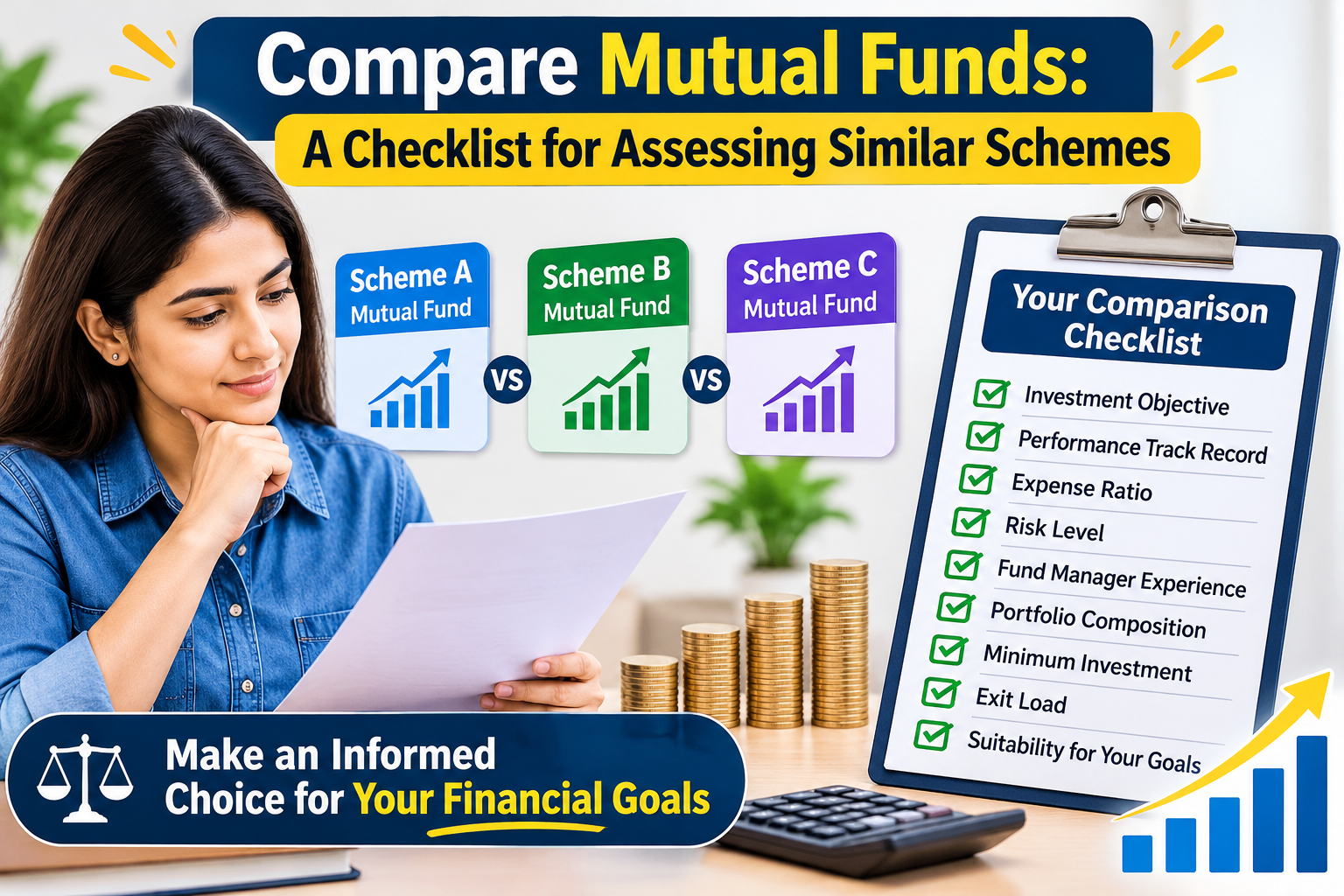
Two mutual funds can belong to the same category and still behave differently. One may hold a concentrated portfolio, another may spread investments more widely, and a third may follow a different approach to selecting securities. Their recent returns reveal only part of that picture.
To compare mutual funds meaningfully, begin with schemes intended to perform a similar role. Then examine what produced their returns, the risks involved and the costs of holding them. Before you invest in mutual funds, this checklist can help you move beyond performance rankings towards a more useful assessment.
1. Confirm that the comparison is fair
Start with the scheme category, investment objective and strategy. Comparing a sector-focused equity fund with a diversified equity fund can confuse differences in exposure with differences in management.
Even within a category, read the investment mandate. Check where the scheme can invest and how much flexibility the manager has.
Use the latest Scheme Information Document, Key Information Memorandum and relevant addenda. These documents establish what the scheme is designed to do and whether its terms have changed. SEBI’s prescribed scheme-document format also directs investors to check subsequent updates.
2. Match the plan, option and observation dates
When you compare mutual funds, match Direct plans with Direct plans, or Regular plans with Regular plans. Otherwise, differences in distribution costs can distort your assessment.
AMFI explains that Direct and Regular plans of the same scheme share a common portfolio and fund manager but have different expenses and separate NAVs.
Match the option too. Comparing NAV growth across Growth and IDCW options without accounting for distributions can misrepresent performance.
Finally, use the same reporting date. A return measured after a sharp market movement is not directly comparable with one ending before it.
3. Examine returns across several periods
A one-year leader may have benefited from a particular sector or investment style. Review several periods, including weaker market phases, to understand how dependent performance has been on favourable conditions.
Check returns against the scheme’s stated benchmark. For equity schemes, use comparable total-return benchmarks rather than mixing price-index and total-return figures.
Rolling returns can add perspective. These measure returns over repeated periods of equal length, reducing dependence on one selected start and end date. They remain historical observations, not forecasts.
Avoid selecting a scheme solely because it recently ranked first.
Past performance may or may not be sustained in future.
4. Compare the risks behind those returns
Read the latest scheme Riskometer alongside the benchmark Riskometer. SEBI requires disclosure of both when scheme performance is presented against its benchmark.
Then examine risks relevant to the category:
- For equity funds, check company concentration, sector exposure and market-cap allocation.
- For debt funds, examine credit quality, issuer concentration and interest-rate sensitivity.
- For hybrid funds, assess the equity-debt mix and how widely the allocation can change.
Historical volatility and drawdowns can help you understand the experience of holding a scheme. Neither captures every risk, and similar Riskometer labels do not mean identical portfolios.
5. Look inside the portfolio
Review holdings rather than relying on the scheme name. Two funds with different names may own many of the same securities.
Check the weight of the largest holdings and sectors. For debt schemes, examine exposure to individual issuers and related groups as well as maturity characteristics.
If you already invest in mutual funds, assess overlap with your existing holdings. Another fund may increase the number of schemes in your account without meaningfully broadening exposure.
Use comparable portfolio dates and review more than one snapshot where possible. A single month’s holdings may not fully represent a manager’s usual approach.
6. Assess costs on a consistent basis
Compare the latest disclosed expenses for the same plan type. Read the components carefully rather than treating every displayed expense figure as an identical measure.
AMFI’s current disclosure framework distinguishes the base expense ratio from brokerage, transaction costs and statutory levies. A base expense figure alone therefore does not describe every cost component.
Published NAV-based returns already reflect expenses charged within the scheme. Do not subtract those expenses again when comparing historical returns.
When you compare mutual funds tracking the same index, also review tracking difference and tracking error. Lower expenses are useful, but implementation affects the result too.
7. Check continuity and access to your money
Review the current fund manager’s tenure and any material changes in strategy. A long performance record may include periods managed by someone else.
Check withdrawal terms, including exit loads and any lock-in. These are different: an exit load is a charge under specified redemption conditions, while a lock-in restricts redemption.
If you invest in mutual funds through instalments, check how the relevant conditions apply to each allotment. Also consider whether switching an existing investment could create tax consequences or exit charges.
Conclusion
Compare mutual funds using similar mandates, matching plans and consistent periods. Assess portfolios, risks, expenses, management continuity and withdrawal terms alongside returns. The purpose is to identify a scheme suited to your goal and existing holdings, rather than simply choosing the latest performance leader.
Mutual Fund investments are subject to market risks, read all scheme related documents carefully.
This document should not be treated as endorsement of the views/opinions or as investment advice. This document should not be construed as a research report or a recommendation to buy or sell any security. This document is for information purpose only and should not be construed as a promise on minimum returns or safeguard of capital. This document alone is not sufficient and should not be used for the development or implementation of an investment strategy. The recipient should note and understand that the information provided above may not contain all the material aspects relevant for making an investment decision. Investors are advised to consult their own investment advisor before making any investment decision in light of their risk appetite, investment goals and horizon. This information is subject to change without any prior notice.
The content herein has been prepared on the basis of publicly available information believed to be reliable. However, Bajaj Asset Management Limited (formerly known as Bajaj Finserv Asset Management Limited) does not guarantee the accuracy of such information, assure its completeness or warrant such information will not be changed. The tax information (if any) in this article is based on prevailing laws at the time of publishing the article and is subject to change. Please consult a tax professional or refer to the latest regulations for up-to-date information.